Basics of Water Management
Key Terms:
Water Right
Acre-foot
Riparian Rights
Appropriative Rights
Groundwater Rights
Federal Reserved Water Rights
Adjudication
A water right is a “legal permission to use a reasonable amount of water for a beneficial purpose” (State Water Resources Control Board). While each state has a slightly different water rights system, they all evolved out of the settler-colonial approach of dividing and claiming resources. In California, there are two main types of surface water rights: riparian and appropriative. Water rights have different priority based on how long ago they were claimed, which is often summarized as “first in time, first in right.”
first in time, first in right
How much is an acre-foot?
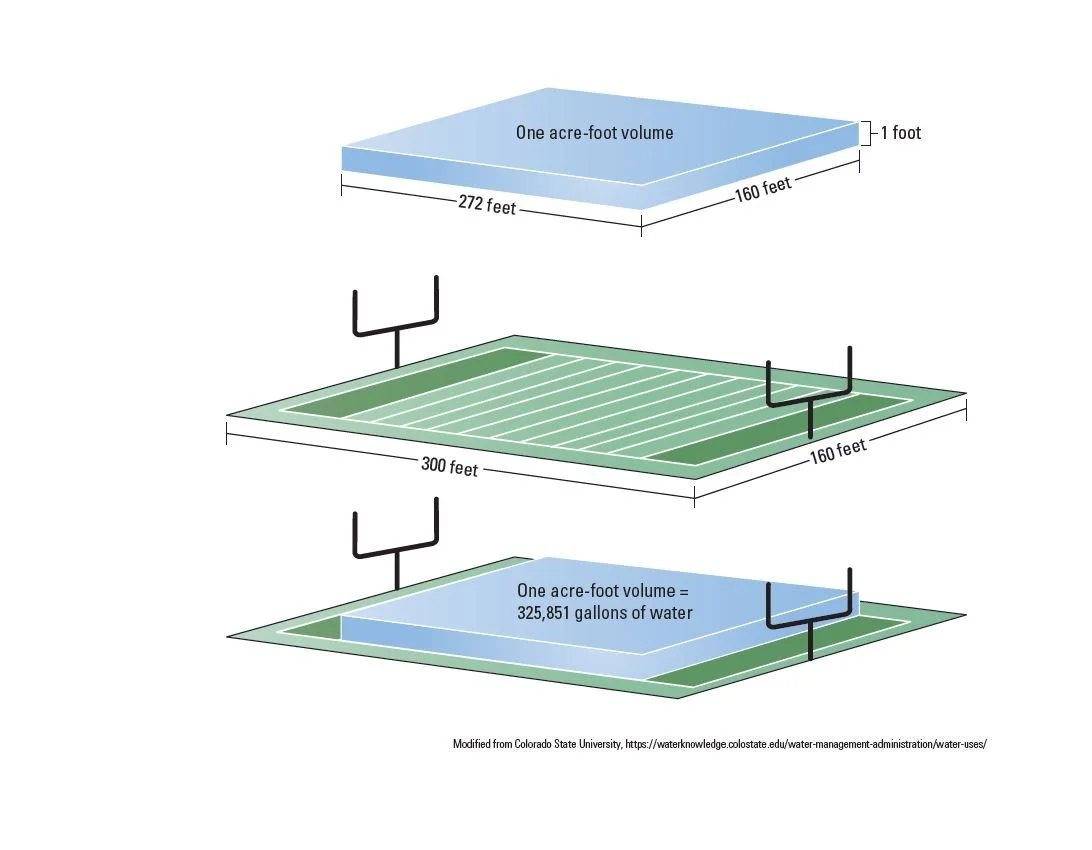
An acre-foot is the most common unit of measurement for water, though there are other measurements like miner’s inch and cubic feet per second. One acre-foot is the volume equivalent to a football field (minus the endzones) full of one foot of water. It is equal to 43,560 cubic feet or 325,851 gallons.
In California, an acre-foot can support the annual needs of a little over three households (Water Education Foundation, 2018).
Riparian Rights
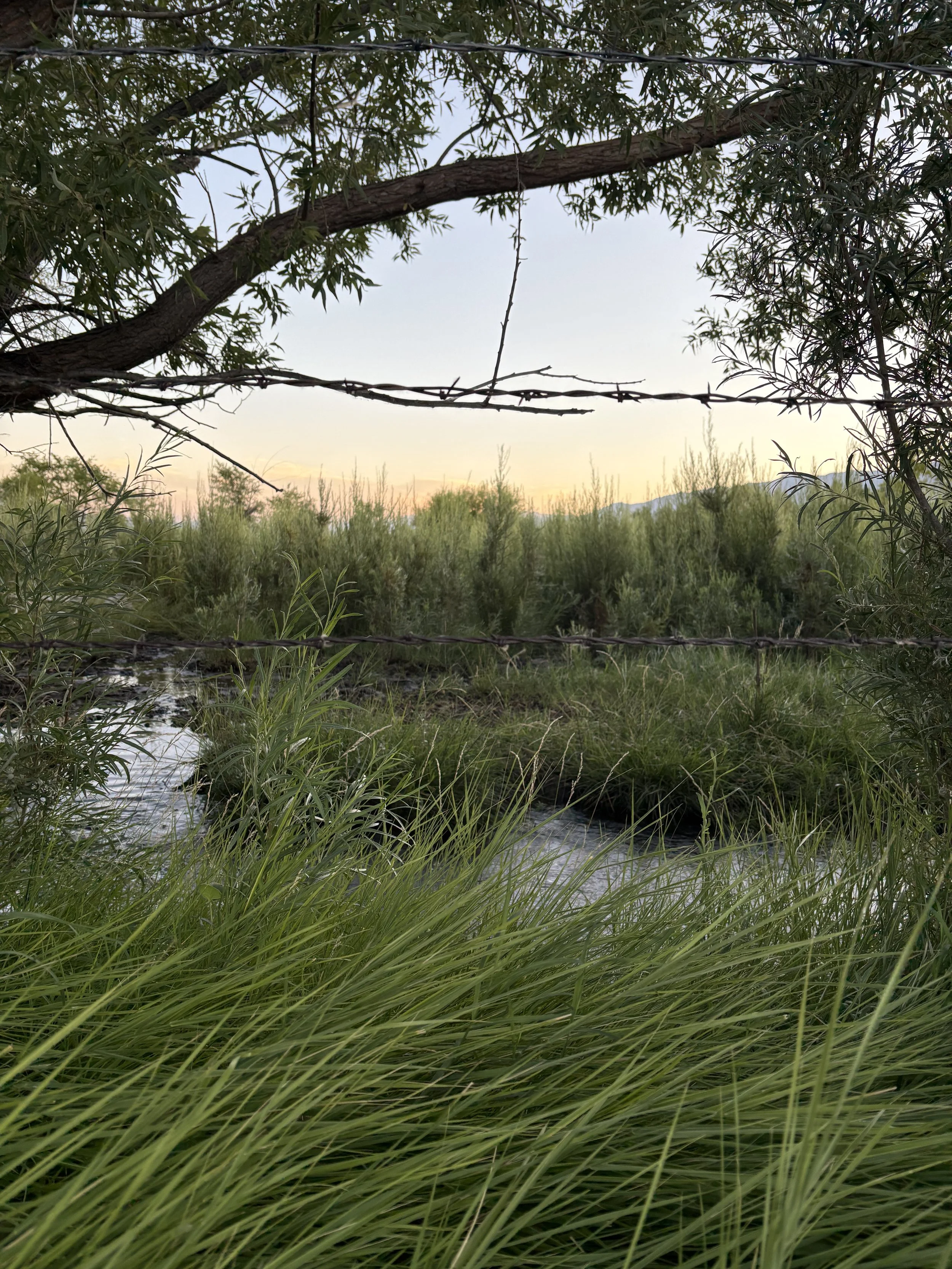
A riparian water right is a right that can only occur on riparian land, which is land directly next to a body of water such as a creek or lake. The water right is for the diversion of a certain amount of the natural flow from the body of water and can only be used on the parcel of land tied to the water right. Under a riparian water right, the water cannot be stored, so in drier years there may not be enough water for use as a riparian right. Riparian rights may be “dormant” if they are not currently being used, but they are not lost during non-use. Riparian rights are only sold or transferred by the transfer of the riparian land they belong to. California is unique in having riparian rights because most western states no longer recognize riparian rights. Not all riparian land has corresponding riparian water rights.
Appropriative Rights
Appropriative rights are the right to divert surface water for a “beneficial use” on non-riparian land or land that wouldn’t naturally have that water on it. This right is not based on land ownership, but rather on the actual diversion and beneficial use of water. Beneficial uses may include, but are not limited to, use for farming, fishing, recreation, or domestic household use.
The State Water Commission began issuing water permits in 1914, so pre-1914 appropriative rights do not need to file for a permit. Appropriative rights can be lost if the right is not used for five or more consecutive years.
Groundwater Rights
An overlying water right is a right to the beneficial and reasonable use of groundwater on land overlying the aquifer. Use of groundwater on land that is not overlying it is an appropriative groundwater right. Groundwater pumping is usually permitted by local agencies and not by the state, though the State Water Resources Control Board does have the authority to intervene in groundwater pumping that is wasteful, unreasonable, or impacts state resources.
Federal Reserved Water Rights - The Winters Doctrine
Federal reserved water rights are the water rights related to land that the federal government reserves for a specific purpose, such as tribal reservations and national parks. They are typically not subject to state law and usually have the highest priority. Federal reserved water rights for reservations have been defined by The Winters Doctrine, the result of a Supreme Court case in 1908. The Winters Doctrine holds that reservations have a right to the amount of water needed to fulfill the purpose of the reservation, with priority based on the date of establishment.
In Payahuunadü, the Bishop, Big Pine, and Lone Pine Tribes have thus far been unable to receive their federal reserved water rights because of the 1939 Land Exchange that created their reservations. The Owens Valley Indian Water Commission has been working with the three tribes to advocate for their water rights for decades.
Adjudication
Adjudication is the legal process by which water rights are quantified and prioritized for parties with competing claims to surface or groundwater. An adjudicated basin is a watershed in which all the water rights have been legally recognized and described by the courts.
references
“Water Rights: Frequently Asked Questions.” State Water Resources Control Board, California Environmental Protection Agency. 30 Sep. 2024, https://www.waterboards.ca.gov/waterrights/board_info/faqs.html#toc178761088.
Accessed 15 July 2025.
“Water Rights Terms.” Aquapedia, Water Education Foundation. https://www.watereducation.org/aquapedia/helpful-water-rights-terms.
Accessed 15 July 2025.